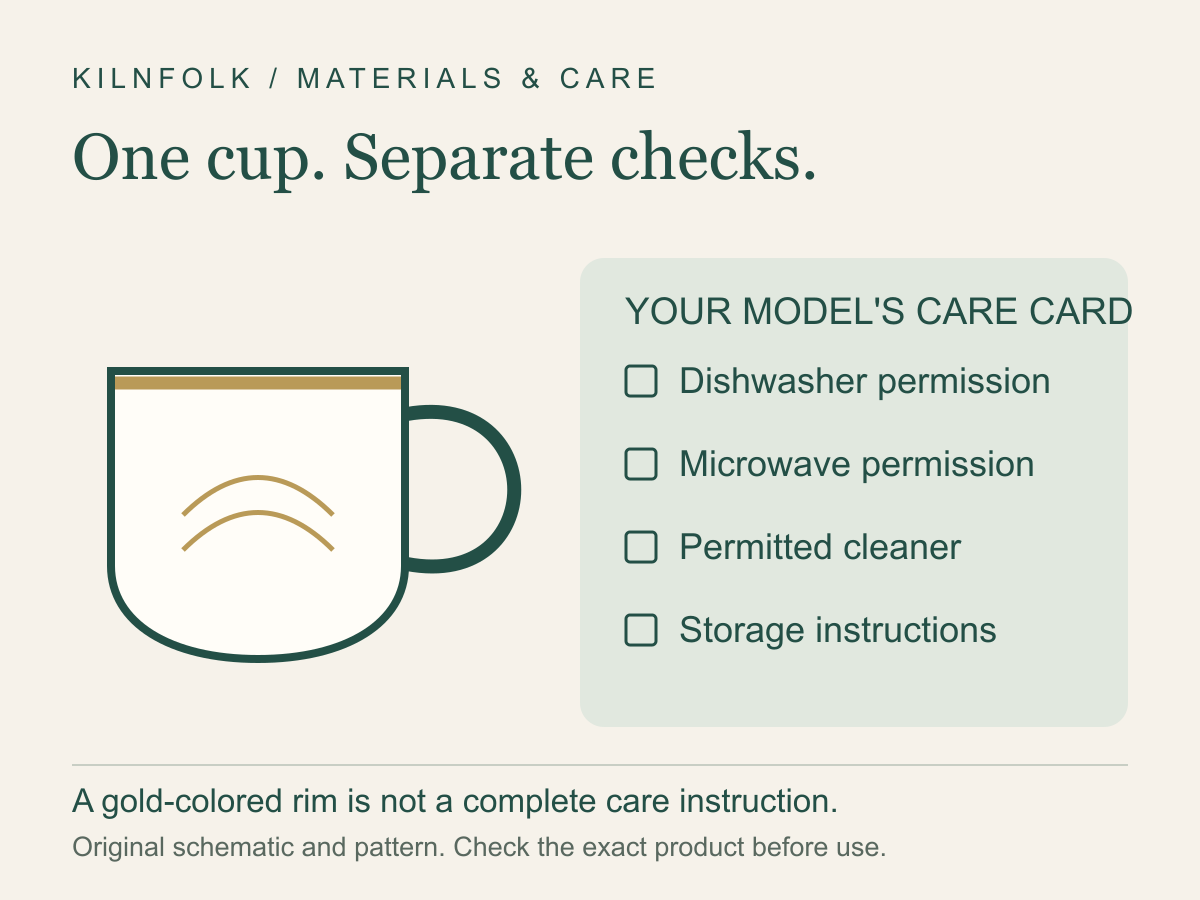
Use a practical care checklist for decorated cups, with two gold-accented Lenox examples and separate checks for washing, reheating and cleaning methods.
This is a research-based guide. Product specifications and care instructions should be checked with the manufacturer. Hands-on testing is only described when documented.
Care for a decorated cup using the instructions for its exact model and finish. Check dishwasher permission and microwave permission separately. A gold-colored rim alone cannot establish either: some identified products carry explicit permissions, while other listings leave heating suitability unresolved.
Two gold-accented examples with different information
Lenox's US pages provide a useful comparison. We reviewed the product descriptions and expanded details on October 18, 2026. These are examples of how to read instructions, not a recommendation to buy either product.
| What to record | Trianna White Mugs, set of 4 | Mugs in Holiday 12-Piece Plate & Mug Set |
|---|
| Item number | 897317 | 6122048 |
| Decoration described | Gold accents on the top rims | 24-karat gold accents and holly-and-berry motif |
| Listed mug capacity | 12 oz each | 10 oz each |
| Dishwasher statement | Dishwasher safe | Dishwasher safe |
| Microwave statement | Explicitly microwave safe, including the gold accents | Not stated in the reviewed product details |
For Trianna, the manufacturer provides affirmative microwave information. For the Holiday set, the reviewed page provides dishwasher information without supplying the same microwave permission. “Not stated” is an evidence gap, not a test result. Lenox's general instructions say not to microwave an item unless the bottom is marked microwave safe, so check the actual item rather than borrowing Trianna's permission.
There is another reason to be precise about the Holiday set: its item details say porcelain, while the broader collection description refers to ivory bone china. We have not resolved that wording difference. This guide uses the exact item's listed capacity, decoration and care statements; it does not rely on the disputed material description to decide how to clean or heat it.
A routine washing checklist
The Lenox Product Use & Care guide gives instructions for its china and porcelain. For these Lenox examples, the following checklist distills that guidance. For another maker's cup, use that maker's instructions instead.
- Read the base first. Confirm the dishwasher-safe marking before choosing a machine cycle. Keep the product instructions with any gift or secondhand set.
- If washing by hand, protect the sink. Lenox recommends a towel or rubber mat beneath china. Use mild detergent; avoid scouring powders, heavy-duty detergents and steel-wool pads.
- If using the dishwasher, separate the pieces. Position permitted items so they do not touch one another or shift under the water action. Keep metal utensils and cookware from contacting the china. Follow the maker's detergent and cycle guidance.
- Let pieces cool before unloading. Lenox includes this instruction for both china and porcelain. Do not turn unloading into a hot-to-cold rinse.
- Rinse and dry after cleaning. Inspect the decoration and surface as you put the cup away. Pause if you notice damage rather than escalating to a stronger treatment.
Handwashing may be your preference even for a dishwasher-permitted item. That preference should not be rewritten as “the manufacturer says handwash only” when the product page says otherwise.
Tea stains, metal marks and a dull-looking rim
These are different problems. Identify the mark and the cup before picking a treatment. Lenox's china guidance distinguishes food or beverage stains, marks left by metal objects, and tarnish on gold or platinum details. It recommends gentle, non-abrasive cleaning for those situations and cautions that excessive rubbing of metallic details may cause damage.
Do not start with a rough pad or treat the decorated area as a surface that needs polishing until it shines. The goal is to follow the permitted cleaning method, not to remove the decoration along with the mark. If you cannot distinguish a stain from worn decoration, ask the manufacturer before continuing.
Some manufacturer care pages include stronger stain treatments for specified materials. We do not turn those into a recipe for every painted, gilt, repaired or vintage cup. The correct product, condition and applicability of the instructions must be established first.
Avoid guessing about heat and storage
Lenox tells users not to subject china to extreme temperature changes and to have serving pieces at room temperature before adding hot food. For a cup kept in a cold location, do not assume its material label grants permission for an abrupt temperature change. Follow the particular maker's guidance.
Its china storage guidance also advises leaving space between items and cushioning pieces when stacking them. That does not establish that any mug handle or rim is a suitable support for a stack. A simple option for a cup without a documented stacking design is to give it its own shelf space, with room to take hold of the handle.
For decorated cups used only occasionally, keep a short care card: maker, pattern, item number, dishwasher marking, microwave marking, source URL and date checked. This avoids relying on memory or on the instructions for a visually similar cup.
When the maker or finish is unknown
An unidentified gold-colored line might not have the same composition as the gold accents in either example here. A seller's photograph cannot resolve that question. If the cup is vintage, repaired or missing its markings, seek product-specific guidance before heating it or applying a stain treatment. Use a different, clearly suitable cup when the intended use remains uncertain.
The microwave-label guide explains the heating decision in more detail. The porcelain and stoneware comparison shows why the material name alone is not a care instruction.
Research note: product pages and care instructions checked October 18, 2026. The checklist illustration is original and uses no manufacturer photos or copied pattern artwork. We have not tested these cups or their cleaning methods.