Match microwave permission to the exact mug and finish. Read manufacturer examples, check the oven manual, and know what to do when a label is missing.
This is a research-based guide. Product specifications and care instructions should be checked with the manufacturer. Hands-on testing is only described when documented.
Use a mug in the microwave only when you can confirm the permission for that exact product and follow your oven's instructions. “Porcelain,” “stoneware” and “dishwasher-safe” are not substitutes for a microwave-safe statement. When the product cannot be identified or the instructions conflict, choose a different, clearly labeled container while you ask the maker.
Read the whole label, not just the material
Start with the bottom of the mug, its packaging and its product number. Look for an explicit microwave-safe statement and any accompanying restrictions. A familiar-looking symbol should be checked against the maker's explanation; our illustration uses plain words to show the decision process and does not reproduce a certification mark.
Then match the exact model and finish to the manufacturer's current information. A care statement for a plain mug does not automatically cover a decorated version, an older edition or a matching lid. If the base marking and the online listing disagree, do not decide by whichever instruction is more convenient. Ask the manufacturer which applies to your item.
The Lenox care guide is particularly explicit: an item without a microwave-safe marking on the bottom should not go in the microwave. It also says not to heat the item empty. Those instructions are more useful than guessing from a ceramic's appearance.
Four examples of what the evidence actually says
These manufacturer pages were checked on October 18, 2026. “Not confirmed” below means the page did not supply that permission; it is not a claim that we tested the product and found it unsafe.
| Identified product | Manufacturer information | Practical reading |
|---|
| IKEA 365+ white mug, 802.783.67 | Feldspar porcelain; microwave-safe; dishwasher-safe | Permission is listed for this mug; check the item and accompanying instructions |
| IKEA DINERA beige mug, 603.506.46 | Stoneware; microwave-safe; dishwasher-safe | A different material can carry the same permissions |
| Lenox Trianna White Mugs, 897317 | Porcelain; microwave safe; dishwasher safe; explicitly microwave-safe gold accents | This exact decorated model has stated permission; also check the base marking required by Lenox |
| Mugs in Lenox Holiday 12-Piece Plate & Mug Set, 6122048 | 24-karat gold accents; dishwasher safe; no microwave-safe statement in the reviewed details | Dishwasher permission does not resolve microwave use; do not infer approval |
The last two examples explain why “gold-looking” is not a complete decision rule. One product has an explicit statement about its decoration; the other reviewed listing does not. Neither page gives permission to microwave an unidentified vintage cup or another gold-trimmed pattern.
Check the microwave oven's instructions too
The FDA's microwave-oven guidance says the instructions supplied with each oven identify the kinds of containers to use. It generally advises against metal pans and aluminum foil because reflected microwaves can affect heating and may damage the oven.
That general guidance is not a way to identify the composition or suitability of a decorative finish from a photograph. Use the mug maker's instructions together with the oven manual. If a decorated mug's stated permission appears inconsistent with your oven's restrictions, use a clearly compatible alternative and ask for clarification.
Microwave-safe does not mean cool to touch
The FDA explains that containers can become hot from the food inside them. Lenox tells users to handle heated items with an oven mitt or potholder. A mug that feels hot afterward is therefore not, by itself, evidence that its label is false; nor does a cool-feeling handle certify an unknown mug as safe.
The FDA also warns that overheated water can erupt from a cup and cause scalding. Follow the oven manufacturer's heating-time guidance. Do not adopt a single heating time from this article for every volume, oven power level or mug: this guide does not prescribe one.
What if there is no label?
Look for a maker's name and product number, then ask the manufacturer. Include the finish, approximate age if known, photographs of the markings and your intended use. A product sold as a serving cup is not necessarily approved as a heating container.
We do not offer a homemade microwave test as a replacement for the maker's permission. The FDA points readers to their oven manual for container-testing instructions, but a generic online “one-minute test” does not identify an unknown decoration or resolve contradictory product instructions. Do not use it to override a “not microwave safe” label.
While you wait for an answer, use another container whose suitability is clear. If a mug is chipped, cracked or otherwise damaged, pause use and seek the maker's guidance rather than assuming the original permission still settles its condition.
A three-part check before reheating
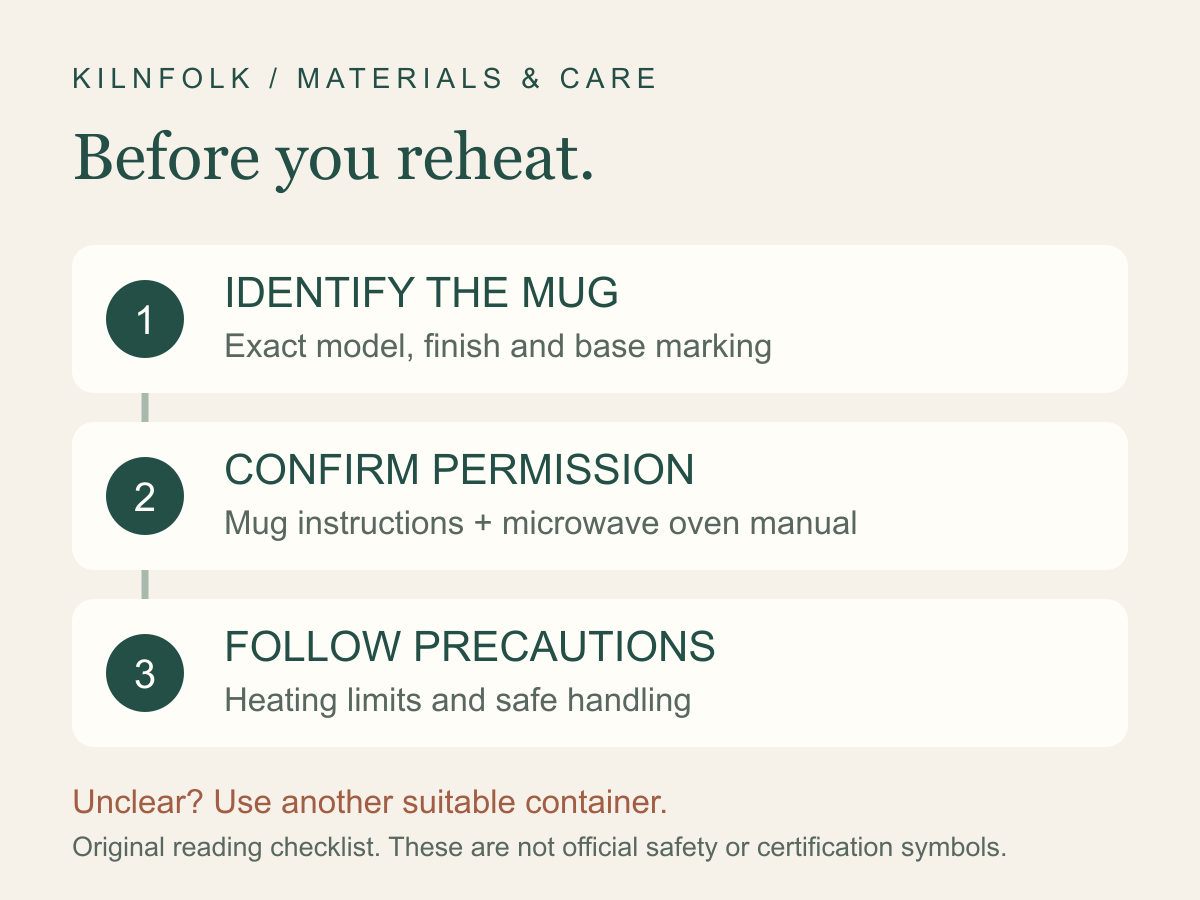
- Identify: the model, finish, base marking and any separate components.
- Confirm: the manufacturer's microwave permission and your oven's container instructions agree.
- Follow: the stated use, heating and handling precautions. If a point remains unresolved, use a different suitable container.
Read Porcelain vs Stoneware Mugs for a model comparison, or Caring for Decorated and Gold-Rimmed Cups for the separate washing checklist.
Research note: sources checked October 18, 2026. This guide reports manufacturer and FDA instructions; it does not certify products, reproduce official safety symbols or describe hands-on microwave tests.