Compare mug capacities in US fl oz and mL, distinguish labeled capacity from everyday fill, and check real manufacturer dimensions before choosing.
This is a research-based guide. Product specifications and care instructions should be checked with the manufacturer. Hands-on testing is only described when documented.
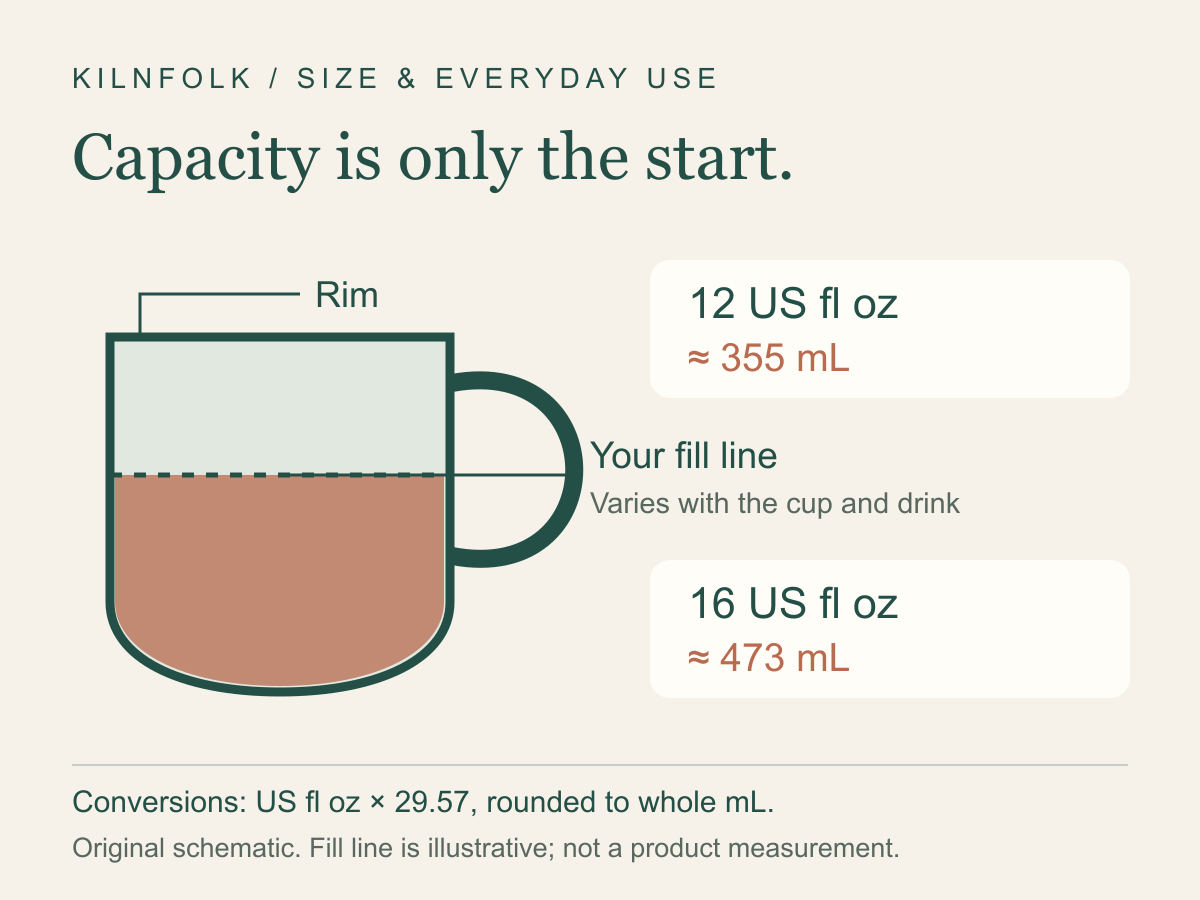
Choose a mug around the volume of the drink you actually make, then check its usable fill level and outside dimensions. A 12 US fl oz capacity converts to about 355 mL; 16 US fl oz converts to about 473 mL. Neither number, by itself, tells you how much hot coffee you can comfortably carry in that particular mug.
Coffee mug sizes in US fluid ounces and milliliters
In this guide, fl oz means US fluid ounces, a unit of volume. It does not mean the weight of the mug. The NIST conversion table gives the approximate factor 1 US fl oz = 29.57 mL. Multiply by 29.57 and round to the nearest whole milliliter for the table below.
| Capacity in US fl oz | Approximate volume in mL |
|---|
| 6 | 177 |
| 8 | 237 |
| 10 | 296 |
| 12 | 355 |
| 14 | 414 |
| 16 | 473 |
| 20 | 591 |
These are calculated conversions, not measurements of products. They do not establish a standard serving size for espresso, a latte or drip coffee. If a listing only says “oz,” check its market and unit convention; do not substitute an Imperial fluid ounce or a weight-ounce conversion. Keep the manufacturer's original figure beside any conversion you make.
Labeled capacity, brimful capacity and everyday fill
These three descriptions answer different questions. Labeled capacity is the number the manufacturer publishes. Brimful capacity describes filling to the rim. Everyday fill is the amount you choose to put in the cup for your routine, with space for additions, stirring and movement.
A manufacturer may explain how it measures capacity, but the number alone does not identify its method. If a listing does not define its fill level, record that as unknown. There is no percentage deduction in this guide that makes every “12 oz” mug a verified 10 oz serving mug: the shape, rim and way you use it matter.
Our illustration separates the capacity label from the fill line. The line is schematic, not a recommendation to fill every cup to the same height or proportion.
Three manufacturer examples: volume is not height
These US product pages were checked on October 18, 2026. We retained their capacity labels as printed rather than treating them as measured US fl oz values. The height figures below are product dimensions, not shipping-box dimensions.
| Exact product | Published capacity | Published height |
|---|
| IKEA 365+ white mug, article 802.783.67 | 12 oz | 3 in |
| IKEA DINERA beige mug, article 603.506.46 | 10 oz | 3 1/2 in |
| Lenox Trianna White Mugs, set of 4, item 897317 | 12 oz per mug | 4.5 in |
The two 12 oz listings have different heights. The 10 oz DINERA is taller than the 12 oz IKEA 365+. This is why choosing by capacity alone cannot establish whether a mug fits beneath a coffee-machine spout. The Lenox page also lists a 3.75 in diameter; do not assume that includes the handle.
The specifications we reviewed do not define a brimful-versus-recommended serving convention for these examples. We have not measured their capacities or tested them with a coffee machine. Follow the linked product pages for current specifications; these examples are comparison references, not rankings.
Should you choose 12 oz or 16 oz?
Start with the finished drink, including milk. As a clearly hypothetical example, 10 US fl oz of coffee plus 2 US fl oz of milk totals 12 US fl oz, or about 355 mL. Choosing a cup labeled 12 oz on that arithmetic alone leaves the space for stirring or carrying unresolved. A larger candidate gives you another size to investigate, but its comfortable fill level still needs checking.
If your finished drink is smaller, a 12 oz candidate may be enough. If you regularly add more liquid or foam, compare larger options. Neither choice is automatically better, and a 16 oz cup does not require you to brew 16 oz of coffee.
Use this short worksheet before ordering:
- Measure your usual finished drink with a measuring jug and write down the unit.
- Identify the mug's exact model and the manufacturer's capacity figure.
- Look for an explanation of how that capacity was measured. Ask the maker if the distinction affects your choice.
- Check height, diameter and handle span against the space you actually have.
- When the mug arrives, compare your intended fill with room-temperature water before using it for a hot drink. This checks fit and your preferred fill, not microwave suitability.
Check care requirements separately
Capacity does not tell you whether a mug is suitable for reheating or dishwasher cleaning. The porcelain and stoneware comparison shows how to compare actual models. If reheating matters, use the microwave-label guide before choosing.
Research note: manufacturer pages and the NIST table were checked on October 18, 2026. All conversions and the fill-line illustration are editorial calculations or schematics. No hands-on product testing was performed.